
CV计算机视觉核心09-图像分割FCN(Penn-Fudan Database数据集)
CV计算机视觉核心09-图像分割FCN(Penn-Fudan Database数据集)
·
CV计算机视觉核心09-图像分割FCN(Penn-Fudan Database数据集)
Penn-Fudan Database数据集下载地址:https://www.cis.upenn.edu/~jshi/ped_html/
1、首先读取数据
PennFudanDataset_main.py:
import os
import numpy as np
import torch
from PIL import Image

class PennFudanDataset(object):
    def __init__(self, root, transforms):
        self.root = root
        self.transforms = transforms
        # load all image files, sorting them to
        # ensure that they are aligned
        self.imgs = list(sorted(os.listdir(os.path.join(root, "PNGImages"))))
        self.masks = list(sorted(os.listdir(os.path.join(root, "PedMasks"))))

    def __getitem__(self, idx):
        # load images ad masks
        img_path = os.path.join(self.root, "PNGImages", self.imgs[idx])
        mask_path = os.path.join(self.root, "PedMasks", self.masks[idx])
        img = Image.open(img_path).convert("RGB")
        # note that we haven't converted the mask to RGB,
        # because each color corresponds to a different instance
        # with 0 being background
        mask = Image.open(mask_path)
        # convert the PIL Image into a numpy array
        mask = np.array(mask)
        # instances are encoded as different colors
        obj_ids = np.unique(mask)
        # first id is the background, so remove it
        obj_ids = obj_ids[1:]

        # split the color-encoded mask into a set
        # of binary masks
        masks = mask == obj_ids[:, None, None]

        # get bounding box coordinates for each mask
        num_objs = len(obj_ids)
        boxes = []
        for i in range(num_objs):
            pos = np.where(masks[i])
            xmin = np.min(pos[1])
            xmax = np.max(pos[1])
            ymin = np.min(pos[0])
            ymax = np.max(pos[0])
            boxes.append([xmin, ymin, xmax, ymax])

        # convert everything into a torch.Tensor
        boxes = torch.as_tensor(boxes, dtype=torch.float32)
        # there is only one class
        labels = torch.ones((num_objs,), dtype=torch.int64)
        masks = torch.as_tensor(masks, dtype=torch.uint8)

        image_id = torch.tensor([idx])
        area = (boxes[:, 3] - boxes[:, 1]) * (boxes[:, 2] - boxes[:, 0])
        # suppose all instances are not crowd
        iscrowd = torch.zeros((num_objs,), dtype=torch.int64)

        target = {}
        target["boxes"] = boxes
        target["labels"] = labels
        target["masks"] = masks
        target["image_id"] = image_id
        target["area"] = area
        target["iscrowd"] = iscrowd

        if self.transforms is not None:
            img, target = self.transforms(img, target)

        return img, target

    def __len__(self):
        return len(self.imgs)
        import transforms as T
import transforms as T
def get_transform(train):
    transforms = []
    transforms.append(T.ToTensor())
    if train:
        transforms.append(T.RandomHorizontalFlip(0.5))
    return T.Compose(transforms)


def main():
    root = './PennFudanPed'
    transforms = get_transform(train=False)
    readData =  PennFudanDataset(root,transforms)
    print(readData.__len__())

if __name__ == '__main__':
    main()
PennFudanDataset_main.py在这个python文件中有使用transforms内容:
transforms.py:
import random
import torch

from torchvision.transforms import functional as F


def _flip_coco_person_keypoints(kps, width):
    flip_inds = [0, 2, 1, 4, 3, 6, 5, 8, 7, 10, 9, 12, 11, 14, 13, 16, 15]
    flipped_data = kps[:, flip_inds]
    flipped_data[..., 0] = width - flipped_data[..., 0]
    # Maintain COCO convention that if visibility == 0, then x, y = 0
    inds = flipped_data[..., 2] == 0
    flipped_data[inds] = 0
    return flipped_data


class Compose(object):
    def __init__(self, transforms):
        self.transforms = transforms

    def __call__(self, image, target):
        for t in self.transforms:
            image, target = t(image, target)
        return image, target


class RandomHorizontalFlip(object):
    def __init__(self, prob):
        self.prob = prob

    def __call__(self, image, target):
        if random.random() < self.prob:
            height, width = image.shape[-2:]
            image = image.flip(-1)
            bbox = target["boxes"]
            bbox[:, [0, 2]] = width - bbox[:, [2, 0]]
            target["boxes"] = bbox
            if "masks" in target:
                target["masks"] = target["masks"].flip(-1)
            if "keypoints" in target:
                keypoints = target["keypoints"]
                keypoints = _flip_coco_person_keypoints(keypoints, width)
                target["keypoints"] = keypoints
        return image, target


class ToTensor(object):
    def __call__(self, image, target):
        image = F.to_tensor(image)
        return image, target
2、fcn模型
fcn.py:
# -*- coding: utf-8 -*-

from __future__ import print_function

import torch
import torch.nn as nn
import torch.optim as optim
from torchvision import models
from torchvision.models.vgg import VGG


class FCN32s(nn.Module):

    def __init__(self, pretrained_net, n_class):
        super().__init__()
        self.n_class = n_class
        self.pretrained_net = pretrained_net
        #[homework] 补齐FCN32s网络各层得定义:
        # ConvTranspose2d中参数一和二是channel通道数的变化。
        self.relu    = nn.ReLU(inplace=True)
        self.deconv1 = nn.ConvTranspose2d(512,512,kernel_size=3,stride=2,padding=1,dilation=1,output_padding=1)
        self.bn1     = nn.BatchNorm2d(512)
        self.deconv2 = nn.ConvTranspose2d(512,256,kernel_size=3,stride=2,padding=1,dilation=1,output_padding=1)
        self.bn2     = nn.BatchNorm2d(256)
        self.deconv3 = nn.ConvTranspose2d(256,128,kernel_size=3,stride=2,padding=1,dilation=1,output_padding=1)
        self.bn3     = nn.BatchNorm2d(128)
        self.deconv4 = nn.ConvTranspose2d(128,64,kernel_size=3,stride=2,padding=1,dilation=1,output_padding=1)
        self.bn4     = nn.BatchNorm2d(64)
        self.deconv5 = nn.ConvTranspose2d(64,32,kernel_size=3,stride=2,padding=1,dilation=1,output_padding=1)
        self.bn5     = nn.BatchNorm2d(32)
        self.classifier = nn.Conv2d(32, n_class, kernel_size=1)

    def forward(self, x):
        #首先提取一下特征,vgg16,这样就可以获得特征值。
        output = self.pretrained_net(x)
        x5 = output['x5']  # size=(N, 512, x.H/32, x.W/32)

        #将x5输入到逆卷积deconv1中,deconv是用来upsampling的
        score = self.bn1(self.relu(self.deconv1(x5)))     # size=(N, 512, x.H/16, x.W/16)
        score = self.bn2(self.relu(self.deconv2(score)))  # size=(N, 256, x.H/8, x.W/8)
        score = self.bn3(self.relu(self.deconv3(score)))  # size=(N, 128, x.H/4, x.W/4)
        score = self.bn4(self.relu(self.deconv4(score)))  # size=(N, 64, x.H/2, x.W/2)
        score = self.bn5(self.relu(self.deconv5(score)))  # size=(N, 32, x.H, x.W)
        score = self.classifier(score)                    # size=(N, n_class, x.H/1, x.W/1)

        return score  # size=(N, n_class, x.H/1, x.W/1)


class FCN8s(nn.Module):

    def __init__(self, pretrained_net, n_class):
        super().__init__()
        self.n_class = n_class
        self.pretrained_net = pretrained_net
        #[homework] 补齐FCN8s各层得定义
        self.relu    = nn.ReLU(inplace=True)
        self.deconv1 = nn.ConvTranspose2d(512,512,kernel_size=3,stride=2,padding=1,dilation=1,output_padding=1)
        self.bn1     = nn.BatchNorm2d(512)
        self.deconv2 = nn.ConvTranspose2d(512,256,kernel_size=3,stride=2,padding=1,dilation=1,output_padding=1)
        self.bn2     = nn.BatchNorm2d(256)
        self.deconv3 = nn.ConvTranspose2d(256,128,kernel_size=3,stride=2,padding=1,dilation=1,output_padding=1)
        self.bn3     = nn.BatchNorm2d(128)
        self.deconv4 = nn.ConvTranspose2d(128,64,kernel_size=3,stride=2,padding=1,dilation=1,output_padding=1)
        self.bn4     = nn.BatchNorm2d(64)
        self.deconv5 = nn.ConvTranspose2d(64,32,kernel_size=3,stride=2,padding=1,dilation=1,output_padding=1)
        self.bn5     = nn.BatchNorm2d(32)
        self.classifier = nn.Conv2d(32, n_class, kernel_size=1)

    def forward(self, x):
        output = self.pretrained_net(x)
        x5 = output['x5']  # size=(N, 512, x.H/32, x.W/32)
        x4 = output['x4']  # size=(N, 512, x.H/16, x.W/16)
        x3 = output['x3']  # size=(N, 256, x.H/8,  x.W/8)
        #[homework] 实现跳级结构
        score = self.relu(self.deconv1(x5))  # size=(N, 512, x.H/16, x.W/16)
        score = self.bn1(score+x4)  # element-wise add, size=(N, 512, x.H/16, x.W/16)
        score = self.relu(self.deconv2(score))  # size=(N, 256, x.H/8, x.W/8)
        score = self.bn2(score+x3)  # element-wise add, size=(N, 256, x.H/8, x.W/8)
        score = self.bn3(self.relu(self.deconv3(score)))  # size=(N, 128, x.H/4, x.W/4)
        score = self.bn4(self.relu(self.deconv4(score)))  # size=(N, 64, x.H/2, x.W/2)
        score = self.bn5(self.relu(self.deconv5(score)))  # size=(N, 32, x.H, x.W)
        score = self.classifier(score)  # size=(N, n_class, x.H/1, x.W/1)

        return score  # size=(N, n_class, x.H/1, x.W/1)


class VGGNet(VGG):
    def __init__(self, pretrained=True, model='vgg16', requires_grad=True, remove_fc=True, show_params=False):
        super().__init__(make_layers(cfg[model]))
        self.ranges = ranges[model]

        if pretrained:
            exec("self.load_state_dict(models.%s(pretrained=True).state_dict())" % model)

        if not requires_grad:
            for param in super().parameters():
                param.requires_grad = False

        if remove_fc:  # delete redundant fully-connected layer params, can save memory
            del self.classifier

        if show_params:
            for name, param in self.named_parameters():
                print(name, param.size())

    def forward(self, x):
        output = {}

        # get the output of each maxpooling layer (5 maxpool in VGG net)
        for idx in range(len(self.ranges)):
            for layer in range(self.ranges[idx][0], self.ranges[idx][1]):
                x = self.features[layer](x)
            output["x%d"%(idx+1)] = x

        return output


ranges = {
    'vgg11': ((0, 3), (3, 6),  (6, 11),  (11, 16), (16, 21)),
    'vgg13': ((0, 5), (5, 10), (10, 15), (15, 20), (20, 25)),
    'vgg16': ((0, 5), (5, 10), (10, 17), (17, 24), (24, 31)),
    'vgg19': ((0, 5), (5, 10), (10, 19), (19, 28), (28, 37))
}

# cropped version from https://github.com/pytorch/vision/blob/master/torchvision/models/vgg.py
cfg = {
    'vgg11': [64, 'M', 128, 'M', 256, 256, 'M', 512, 512, 'M', 512, 512, 'M'],
    'vgg13': [64, 64, 'M', 128, 128, 'M', 256, 256, 'M', 512, 512, 'M', 512, 512, 'M'],
    'vgg16': [64, 64, 'M', 128, 128, 'M', 256, 256, 256, 'M', 512, 512, 512, 'M', 512, 512, 512, 'M'],
    'vgg19': [64, 64, 'M', 128, 128, 'M', 256, 256, 256, 256, 'M', 512, 512, 512, 512, 'M', 512, 512, 512, 512, 'M'],
}

def make_layers(cfg, batch_norm=False):
    layers = []
    in_channels = 3
    for v in cfg:
        if v == 'M':
            layers += [nn.MaxPool2d(kernel_size=2, stride=2)]
        else:
            conv2d = nn.Conv2d(in_channels, v, kernel_size=3, padding=1)
            if batch_norm:
                layers += [conv2d, nn.BatchNorm2d(v), nn.ReLU(inplace=True)]
            else:
                layers += [conv2d, nn.ReLU(inplace=True)]
            in_channels = v
    return nn.Sequential(*layers)


if __name__ == "__main__":
    batch_size, n_class, h, w = 10, 20, 160, 160

    # test output size
    vgg_model = VGGNet(pretrained=False,requires_grad=True)
    input = torch.autograd.Variable(torch.randn(batch_size, 3, 224, 224))
    output = vgg_model(input)
    assert output['x5'].size() == torch.Size([batch_size, 512, 7, 7])

    fcn_model = FCN32s(pretrained_net=vgg_model, n_class=n_class)
    input = torch.autograd.Variable(torch.randn(batch_size, 3, h, w))
    output = fcn_model(input)
    assert output.size() == torch.Size([batch_size, n_class, h, w])

    fcn_model = FCN8s(pretrained_net=vgg_model, n_class=n_class)
    input = torch.autograd.Variable(torch.randn(batch_size, 3, h, w))
    output = fcn_model(input)
    assert output.size() == torch.Size([batch_size, n_class, h, w])


    print("Pass size check")

    # test a random batch, loss should decrease
    fcn_model = FCN32s(pretrained_net=vgg_model, n_class=n_class)
    criterion = nn.BCELoss()
    optimizer = optim.SGD(fcn_model.parameters(), lr=1e-3, momentum=0.9)
    input = torch.autograd.Variable(torch.randn(batch_size, 3, h, w))
    y = torch.autograd.Variable(torch.randn(batch_size, n_class, h, w), requires_grad=False)
    for iter in range(10):
        optimizer.zero_grad()
        output = fcn_model(input)
        output = nn.functional.sigmoid(output)
        loss = criterion(output, y)
        loss.backward()
        import pdb
        pdb.set_trace()
        print("iter{}, loss {}".format(iter, loss.data.item()))
        optimizer.step()
3、训练模型
# -*- coding: utf-8 -*-

from __future__ import print_function

import torch
import torch.nn as nn
import torch.optim as optim
from torch.optim import lr_scheduler
from torch.autograd import Variable
from torch.utils.data import DataLoader
import cv2

from fcn import VGGNet, FCN32s, FCN8s

#from matplotlib import pyplot as plt
import numpy as np
import time
import sys
import os
sys.path.append("../../")
from PennFudanDataset_main import *

#import pdb
#pdb.set_trace()

def collate_fn(batch):
    return tuple(zip(*batch))

n_class    = 2

batch_size = 6
epochs     = 100
lr         = 1e-4
momentum   = 0
w_decay    = 1e-5
step_size  = 50
gamma      = 0.5
configs    = "FCNs-BCEWithLogits_batch{}_epoch{}_RMSprop_scheduler-step{}-gamma{}_lr{}_momentum{}_w_decay{}".format(batch_size, epochs, step_size, gamma, lr, momentum, w_decay)
print("Configs:", configs)


# create dir for model
model_dir = "models"
if not os.path.exists(model_dir):
    os.makedirs(model_dir)
model_path = os.path.join(model_dir, configs)

use_gpu = torch.cuda.is_available()
num_gpu = list(range(torch.cuda.device_count()))

# our dataset has two classes only - background and person
num_classes = 2
# use our dataset and defined transformations
dataset = PennFudanDataset('./PennFudanPed', get_transform(train=True))
dataset_test = PennFudanDataset('./PennFudanPed', get_transform(train=False))

# split the dataset in train and test set
indices = torch.randperm(len(dataset)).tolist()
dataset = torch.utils.data.Subset(dataset, indices[:-50])
dataset_test = torch.utils.data.Subset(dataset_test, indices[-50:])

# define training and validation data loaders
train_loader = torch.utils.data.DataLoader(
        dataset, batch_size=2, shuffle=True, num_workers=4,
        collate_fn=collate_fn)

val_loader = torch.utils.data.DataLoader(
        dataset_test, batch_size=3, shuffle=False, num_workers=4,
        collate_fn=collate_fn)

print("That's it!")


#vgg_model = VGGNet(requires_grad=True, remove_fc=True)
print("not use pretrained VGG model")
vgg_model = VGGNet(pretrained=False,requires_grad=True, remove_fc=True)
fcn_model = FCN8s(pretrained_net=vgg_model, n_class=n_class)

if use_gpu:
    ts = time.time()
    vgg_model = vgg_model.cuda()
    fcn_model = fcn_model.cuda()
    fcn_model = nn.DataParallel(fcn_model, device_ids=num_gpu)
    print("Finish cuda loading, time elapsed {}".format(time.time() - ts))

criterion = nn.BCEWithLogitsLoss()
optimizer = optim.RMSprop(fcn_model.parameters(), lr=lr, momentum=momentum, weight_decay=w_decay)
scheduler = lr_scheduler.StepLR(optimizer, step_size=step_size, gamma=gamma)  # decay LR by a factor of 0.5 every 30 epochs
#optimizer = optim.RMSprop(fcn_model.parameters(), lr=lr, momentum=momentum, weight_decay=w_decay)

# create dir for score
score_dir = os.path.join("scores", configs)
if not os.path.exists(score_dir):
    os.makedirs(score_dir)
IU_scores    = np.zeros((epochs, n_class))
pixel_scores = np.zeros(epochs)


def train():
    for epoch in range(epochs):
        ts = time.time()
        for iter, batch in enumerate(train_loader):
            optimizer.zero_grad()
            inputs = input_process(batch)
            _,labels = target_process(batch)


            #if use_gpu:
            #    inputs = Variable(batch['X'].cuda())
            #    labels = Variable(batch['Y'].cuda())
            #else:
            #    #inputs, labels = Variable(batch['X']), Variable(batch['Y'])
            #    inputs, labels = Variable(batch['X']), Variable(batch['Y'])

            outputs = fcn_model(inputs)
            #import pdb
            #pdb.set_trace()
            loss = criterion(outputs, labels.cuda())
            loss.backward()
            optimizer.step()

            if iter % 10 == 0:
                print("epoch{}, iter{}, loss: {}".format(epoch, iter, loss.data.item()))

        print("Finish epoch {}, time elapsed {}".format(epoch, time.time() - ts))
        torch.save(fcn_model, model_path)

        val(epoch)
        scheduler.step()


def input_process(batch):
    #import pdb
    #pdb.set_trace()
    batch_size=len(batch[0])
    input_batch= torch.zeros(batch_size,3,160,160)
    for i in range(batch_size):
        inputs_tmp = Variable(batch[0][i])
        inputs_tmp1=cv2.resize(inputs_tmp.permute([1,2,0]).numpy(),(160,160))
        inputs_tmp2=torch.tensor(inputs_tmp1).permute([2,0,1])
        input_batch[i:i+1,:,:,:]= torch.unsqueeze(inputs_tmp2,0)
    return input_batch


def target_process(batch):
    batch_size=len(batch[0])
    target_batch= torch.zeros(batch_size,160,160)
    label_batch = torch.zeros(batch_size,2,160,160)
    for i in range(batch_size):
        #只处理batch中的第一张图片
        masks=batch[1][i]['masks']
        masks1=torch.sum(masks,0)
        masks2=(masks1>0).float()
        masks3=torch.tensor(cv2.resize(masks2.numpy(),(160,160)))
        target_batch[i:i+1,:,:] = torch.unsqueeze(masks3,0)
        label_batch[i:i+1,1,:,:] =torch.unsqueeze(masks3,0)
        label_batch[i:i+1,0,:,:] =torch.unsqueeze(1-masks3,0)
        #target = batch['l'].cpu().numpy().reshape(N, h, w)
    return target_batch.numpy(),label_batch

def val(epoch):
    fcn_model.eval()
    total_ious = []
    pixel_accs = []
    for iter, batch in enumerate(val_loader):
        inputs = input_process(batch)
        target,label= target_process(batch)

        output = fcn_model(inputs)
        output = output.data.cpu().numpy()

        N, _, h, w = output.shape
        pred = output.transpose(0, 2, 3, 1).reshape(-1, n_class).argmax(axis=1).reshape(N, h, w)

        for p, t in zip(pred, target):
            total_ious.append(iou(p, t))
            pixel_accs.append(pixel_acc(p, t))

    # Calculate average IoU
    total_ious = np.array(total_ious).T  # n_class * val_len
    ious = np.nanmean(total_ious, axis=1)
    pixel_accs = np.array(pixel_accs).mean()
    print("epoch{}, pix_acc: {}, meanIoU: {}, IoUs: {}".format(epoch, pixel_accs, np.nanmean(ious), ious))
    IU_scores[epoch] = ious
    np.save(os.path.join(score_dir, "meanIU"), IU_scores)
    pixel_scores[epoch] = pixel_accs
    np.save(os.path.join(score_dir, "meanPixel"), pixel_scores)


# borrow functions and modify it from https://github.com/Kaixhin/FCN-semantic-segmentation/blob/master/main.py
# Calculates class intersections over unions
def iou(pred, target):
    ious = []
    for cls in range(n_class):
        pred_inds = pred == cls
        target_inds = target == cls
        intersection = pred_inds[target_inds].sum()
        union = pred_inds.sum() + target_inds.sum() - intersection
        if union == 0:
            ious.append(float('nan'))  # if there is no ground truth, do not include in evaluation
        else:
            ious.append(float(intersection) / max(union, 1))
        # print("cls", cls, pred_inds.sum(), target_inds.sum(), intersection, float(intersection) / max(union, 1))
    return ious


def pixel_acc(pred, target):
    #import pdb
    #pdb.set_trace()
    correct = (pred == target).sum()
    total   = (target == target).sum()
    return correct / total


if __name__ == "__main__":
    val(0)  # show the accuracy before training
    train()
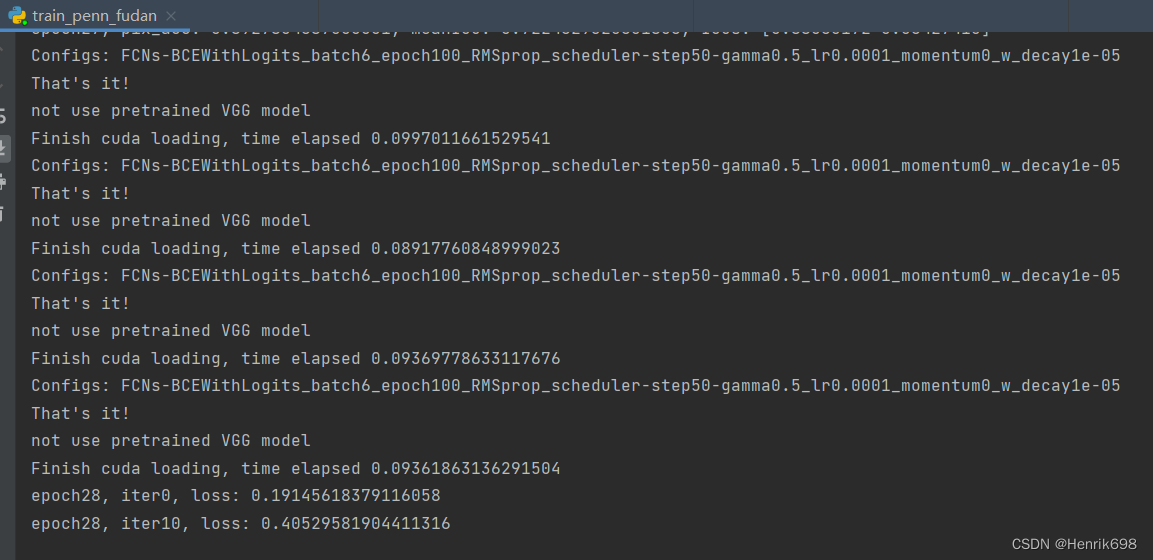
相关代码下载:https://download.csdn.net/download/m0_37755995/86262701

一站式 AI 云服务平台
更多推荐



 1
1 0
0- 0


 已为社区贡献4条内容

所有评论(0)