
算法总结:字符串算法(一)
背景
复健次日,本来想接着做连通图,结果调一个题调了3h才发现自己把i–写成i++了,AI也没发现,气得本人想当场退役,只好看看字符串来压压惊。
一、字符串哈希
模板:P3370
判断两个字符串是否相同,
H
a
s
h
Hash
Hash是个不错的方法。
试想有
1
e
9
1e9
1e9个不同的数字,从中选出
1
e
6
1e6
1e6个,如何判断有多少个不同的数?
我们可以将这些数分别对
1
e
6
1e6
1e6取模,以此判断两数是否相同。
以此类推,对于字符串,我们可以把它类比为一个
B
B
B进制数,通过逐位累加取模便可得到它的
H
a
s
h
Hash
Hash函数。
如果两个字符串的
H
a
s
h
Hash
Hash函数不同,那么它们一定不同,若相同,则它们不一定相同。
这就产生了问题:两个不同的字符串构成了相同的
H
a
s
h
Hash
Hash函数,产生了相撞。
对于最基础的哈希,有以下几种办法避免相撞:
1.将进制
B
B
B和模数
M
M
M调为质数(不会证明)
2.用双哈希(显而易见)
3.相信自己是天命之子(慎用)
代码
#include<bits/stdc++.h>
using namespace std;
#define ll long long
#define B 233
#define M 100000007
int gethash(string s){
    int ans=0;
    for(char c:s){
        ans=(ans*B+c)%M;
    }
    return ans;
}
set<int> s;
signed main(){
    int n;
    string st;
    cin>>n;
    for(int i=1;i<=n;i++){
        cin>>st;
        s.insert(gethash(st));
    }
    cout<<s.size();
    return 0;
}
二、字典树
模板:P8036
字典树(
Trie
\text{Trie}
Trie),是一棵这样的树:
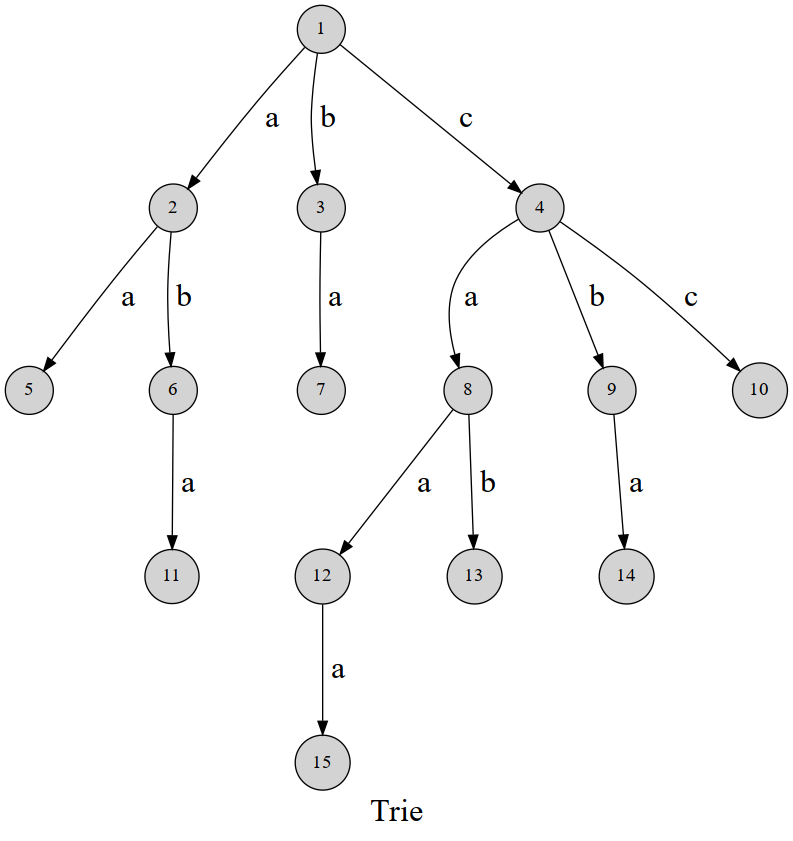
显然,每个结点都代表一个字符,这样的结构能很好地解决前缀问题。
构建字典树的过程中,需要维护三个变量:
1.
i
d
x
idx
idx:字典树的结点数;
2.
a
[
p
o
s
]
[
c
]
a[pos][c]
a[pos][c]:表示
c
c
c字符在第
p
o
s
pos
pos位置时其子结点的位置;
3.
c
n
t
[
p
o
s
]
cnt[pos]
cnt[pos]:记录第
p
o
s
pos
pos位置出现过的字符数量。
建树时,若当前位置无字符,则更新idx,新建结点;
查询时,若当前位置无字符,则说明没有字符串以它为前缀;反之,则有
c
n
t
[
p
o
s
]
cnt[pos]
cnt[pos]个字符串以它为前缀。
另外,由于空间限制,本题需要离散化。
代码
#include<bits/stdc++.h>
using namespace std;
#define N 3000006
int a[N][62],cnt[N];
int T,n,q,idx;
string s;
int find(char c){//离散化
    if(isdigit(c)) return c-'0';
    if(isupper(c)) return c-'A'+10;
    if(islower(c)) return c-'a'+36;
}
void insert(string s){
    int pos=0;
    for(char ch:s){
        int c=find(ch);
        if(!a[pos][c]) a[pos][c]=++idx;
        pos=a[pos][c];
        cnt[pos]++;
    }
}
int query(string s){
    int pos=0;
    for(char ch:s){
        int c=find(ch);
        if(!a[pos][c]) return 0;
        pos=a[pos][c];
    }
    return cnt[pos];
}
int main(){
    cin>>T;
    while(T--){
        idx=0;
        cin>>n>>q;
        for(int i=1;i<=n;i++){
            cin>>s;
            insert(s);
        }
        for(int i=1;i<=q;i++) {
            cin>>s;
            cout<<query(s)<<endl;
        }
        for(int i=0;i<=idx;i++){
            for(int j=0;j<62;j++) a[i][j]=0;
        }
        for(int i=1;i<=idx;i++) cnt[i]=0;//用memset清空数组会爆炸哦
    }
    return 0;
}
三、马拉车( Manacher \pmb {\text{Manacher}} Manacher)
模板:P3805
M
a
n
a
c
h
e
r
Manacher
Manacher算法用于解决最长回文串问题。
首先,我们向字符串开头结尾及每个字符之间加入‘#’,将回文串长度统一为奇数。
暴力方法:枚举中间项和长度,向两边拓展,最终回文串长度为
l
e
n
/
2
len/2
len/2,时间复杂度
O
(
n
2
)
O(n^2)
O(n2)。
以以下字符串为例(省略了‘#’):
a
b
c
e
f
e
c
b
x
b
c
e
f
e
c
b
x
a\ b\ c\ e\ f\ e\ c\ b\ x\ b\ c\ e\ f\ e\ c\ b\ x
a b c e f e c b x b c e f e c b x
在
M
a
n
a
c
h
e
r
Manacher
Manacher算法中,需要维护以下变量:
1.
m
a
x
r
maxr
maxr:表示
[
1
,
i
−
1
]
[1,i-1]
[1,i−1]个字符内可拓展到的最长回文串右边界(如
i
=
12
i=12
i=12时
m
a
x
r
=
15
maxr=15
maxr=15);
2.
m
i
d
mid
mid:表示当前最长回文串的中间项下标(如
i
=
12
i=12
i=12时
m
i
d
=
8
mid=8
mid=8);
3.
p
[
i
]
p[i]
p[i]:表示第
i
i
i个字符可向外拓展的最长长度。
显然,需要更新
p
[
i
]
p[i]
p[i]的值,考虑两种情况:
1
◯
\textcircled 1
1◯
p
[
i
]
>
=
m
a
x
r
p[i]>=maxr
p[i]>=maxr:直接暴力向外拓展即可;
2
◯
\textcircled 2
2◯
p
[
i
]
<
m
a
x
r
p[i]<maxr
p[i]<maxr:依旧以
i
=
12
i=12
i=12为例,对此,
f
f
f一定能找到关于
m
i
d
mid
mid对称的另一个
f
f
f,下标为
m
i
d
×
2
−
i
mid \times 2-i
mid×2−i,即4。
p
[
4
]
p[4]
p[4]显然是计算好的,所以可以利用对称性推出
p
[
12
]
p[12]
p[12]。
考虑到
p
[
4
]
p[4]
p[4]向左拓展,对应
p
[
12
]
p[12]
p[12]会向右拓展。
如果
p
[
4
]
p[4]
p[4]不大于
m
a
x
r
−
i
+
1
maxr-i+1
maxr−i+1,则一定可以拓展到。(因为回文串内是对称的)
反之,则一定不能拓展到,因为不保证
m
a
x
r
maxr
maxr右边字符仍对称,此时
p
[
i
]
p[i]
p[i]的最大值为
m
a
x
r
−
i
+
1
maxr-i+1
maxr−i+1。
代码
#include<bits/stdc++.h>
using namespace std;
#define N 11000005
int p[2*N];//记得乘2
string s="#",s1;
int main(){
    cin>>s1;
    for(char c:s1){
        s.push_back(c);
        s.push_back('#');//不能用加法,因为加法是O(n)的
    }
    int maxr=0,mid=0,ans=0;
    for(int i=0;i<s.size();i++){
        if(i<=maxr) p[i]=min(p[mid*2-i],maxr-i+1);
        else p[i]=1;
        while(i>=p[i]&&i+p[i]<s.size()&&s[i+p[i]]==s[i-p[i]]) p[i]++;//暴力拓展
        if(i+p[i]-1>maxr){
            maxr=i+p[i]-1;
            mid=i;
        }//更新
        ans=max(ans,p[i]*2-1);
    }
    cout<<ans/2;//最终答案
    return 0;
}
四. KMP \pmb{\text{KMP}} KMP
模板:P3375
KMP
{\text{KMP}}
KMP算法用于解决字符串匹配问题。
给出两个字符串
s
1
s_1
s1 和
s
2
s_2
s2,若
s
1
s_1
s1 的区间
[
l
,
r
]
[l, r]
[l,r] 子串与
s
2
s_2
s2 完全相同,则称
s
2
s_2
s2 在
s
1
s_1
s1 中出现了,其出现位置为
l
l
l。
现在请你求出
s
2
s_2
s2 在
s
1
s_1
s1 中所有出现的位置。
定义一个字符串
s
s
s 的 border 为
s
s
s 的一个非
s
s
s 本身的子串
t
t
t,满足
t
t
t 既是
s
s
s 的前缀,又是
s
s
s 的后缀。
对于
s
2
s_2
s2,你还需要求出对于其每个前缀
s
′
s'
s′ 的最长 border
t
′
t'
t′ 的长度。
首先解决第二个任务。
容易知道,一个字符串的border的border仍是它的border,所以通过从最长border往下跳,就能找到它所有的border。
我们不妨假设遍历到第
i
i
i个字符时,前面的最长border已经算好了。
也就是说,用
n
e
x
t
[
i
]
next[i]
next[i]表示以
i
i
i结尾的前缀的最长border长度。(DP复现)
“转移"一下:遍历到
i
i
i时,
n
e
x
t
[
i
−
1
]
next[i-1]
next[i−1]是确定的,此时维护一个
j
j
j,表示前缀的结尾位置。此时只需要判断
s
[
i
]
s[i]
s[i]和
s
[
j
+
1
]
s[j+1]
s[j+1]是否相等。
如果
s
[
i
]
=
s
[
j
+
1
]
s[i]=s[j+1]
s[i]=s[j+1],则匹配出最长border,
n
e
x
t
[
i
]
=
j
+
1
next[i]=j+1
next[i]=j+1
如果
s
[
i
]
≠
s
[
j
+
1
]
s[i]\ne s[j+1]
s[i]=s[j+1],则让
j
j
j跳到
n
e
x
t
[
j
]
next[j]
next[j]位置,继续匹配。
接下来思考第一个任务与
n
e
x
t
next
next数组有何关系。
在暴力方法中,需要逐位匹配两个字符串,如果发现不同则向右移动一位重新匹配。
现在有了
n
e
x
t
next
next数组,当发现两个字符串不匹配时,直接从前缀跳到匹配的后缀位置即可。
最终的时间复杂度为
O
(
∣
s
∣
)
O(|s|)
O(∣s∣)。
代码
#include<bits/stdc++.h>
using namespace std;
#define int long long
#define N 1000006
string s1,s2;
int n1,n2,nxt[N];
signed main(){
    cin>>s1>>s2;
    n1=s1.size(),n2=s2.size();
    s1=' '+s1, s2=' '+s2;
    int j=0;
    for(int i=2;i<=n2;i++){
        while(j&&s2[i]!=s2[j+1]) j=nxt[j];
        if(s2[i]==s2[j+1]) j++;
        nxt[i]=j;
    }
    j=0;
    for(int i=1;i<=n1;i++){
        while(j&&s1[i]!=s2[j+1]) j=nxt[j];
        if(s1[i]==s2[j+1]) j++;
        if(j==n2) cout<<i-n2+1<<endl;
    }
    for(int i=1;i<=n2;i++) cout<<nxt[i]<<' ';
    return 0;
}
懒得写结尾了……

一站式 AI 云服务平台
更多推荐

 6
6 0
0- 0


 已为社区贡献1条内容

所有评论(0)